

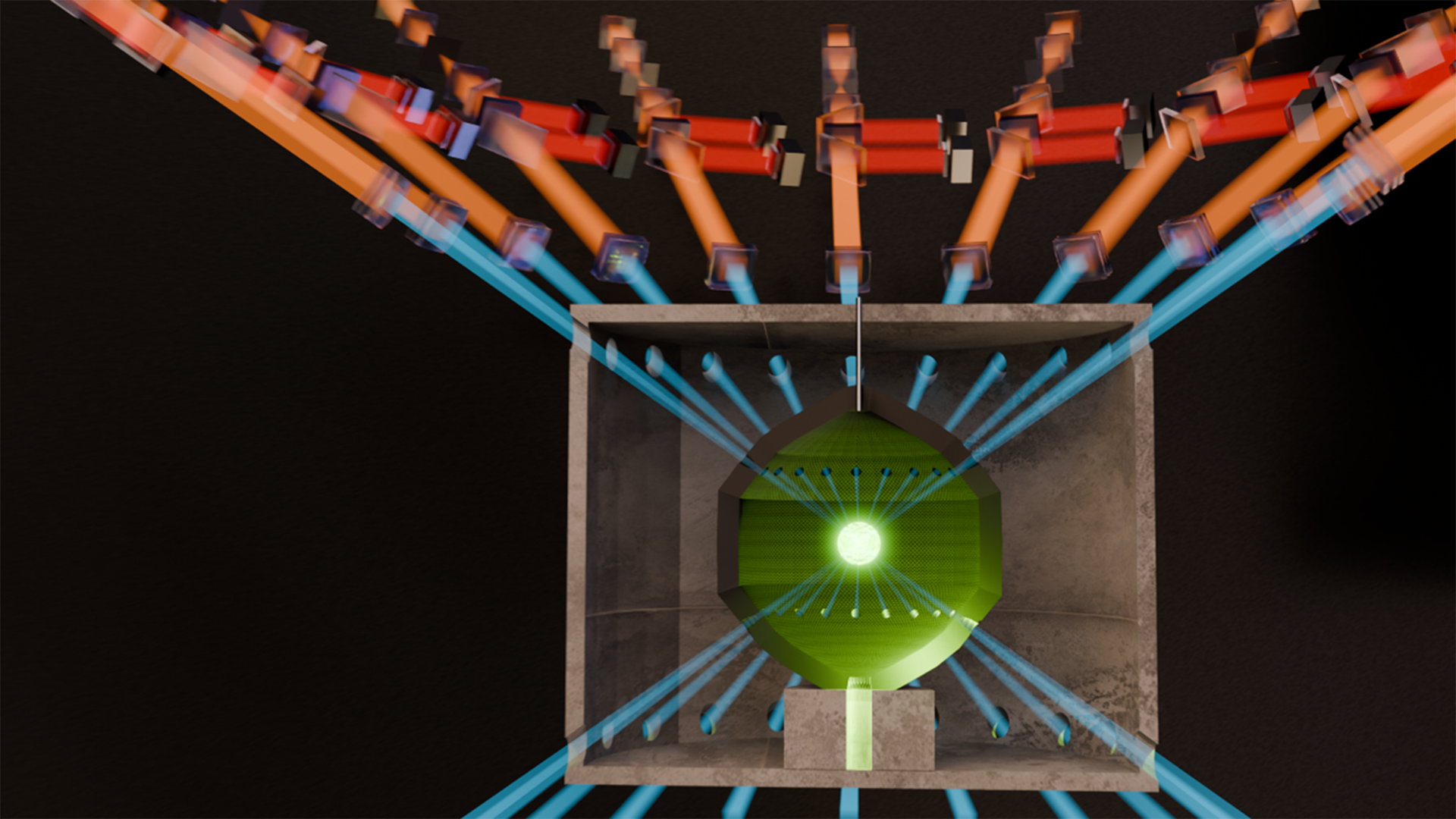
Future climate-neutral fusion power plants need vast numbers of cheaper, improved high-power laser diodes. Germany’s BMFTR-funded DioHELIOS project boosts semiconductor laser power and efficiency while developing automated mass-production approaches
In December 2022, researchers succeeded for the first time in generating excessive energy from a controlled nuclear fusion reaction.1 Since then, the US National Ignition Facility (NIF) at the Lawrence Livermore National Laboratory in California has achieved fusion multiple times beyond scientific break-even with up to fourfold net gain with respect to the optical input energy of their lasers.2 The demonstration of laser-ignited inertial confinement fusion has triggered a new dynamic in fusion research worldwide. This is because fusion not only decouples energy production from the carbon cycle by emitting no greenhouse gases but is also based on an almost unlimited supply of fuel and could, in theory, be operated 24/7 at maximum safety. Germany recognised the new dynamic early on and set up the ‘Fusion 2040’ funding programme in 2024.3
With its partners ams-OSRAM, the Ferdinand-Braun-Institut (FBH), the Fraunhofer Institute for Laser Technology ILT, Jenoptik, LASERLINE, and TRUMPF, the ongoing project ‘DioHELIOS’ (Diode Laser Pump Sources for High-Energy Lasers in Fusion Power Plants) has brought together a broad consortium from the photonics industry and research to advance a key component for fusion power plants of the future: high-power diode laser modules. These are needed as pump sources for the high-energy lasers that compress plasma from hydrogen isotopes to hundreds of billions of atmospheres and ignite it at temperatures ten times hotter than inside the Sun. At NIF, this task is assigned to the world’s largest and highest-energy laser facility. On an area the size of three football fields, 192 beam paths generate over two megajoules of ultraviolet (UV) laser energy per pulse. Conventional flash lamps are used as the pump source – comparatively cheap, but inefficient and unable to operate at the repetition rate required for a power plant, in contrast to laser diodes.

Key components for fusion power plants
Designed with state-of-the-art technology from the 1990s, NIF is intended for basic research in plasma physics; its concept is unsuitable for commercial energy generation, because the lasers need hours to cool down after each shot. In a power plant, such solid-state lasers will have to fire 10-20 times per second. Also, the efficiency of the entire laser system must increase significantly. This could, in fact, be reached with semiconductor lasers (Fig. 1) specifically tuned to the absorption lines of the amplifier medium and able to achieve electrical-to-optical wall plug efficiencies above 70%, instead of broadband-emitting flash lamps. But today’s diode lasers do not quite meet the required performance (irradiance, lifespan, and cost), and they cannot yet be produced in big enough quantities at a workable price: The demand for stacked diode laser bars for a single power plant already exceeds their current annual global production.
As discussed in NIF’s conceptual study ‘Lasers for Inertial Fusion Energy (LIFE)’ 15 years ago, the drive lasers of a single future power plant will need to combine to at least a similar ultraviolet energy as NIF. With a conceivable ~20% conversion efficiency from diode energy to the UV, a ten megajoule optical diode output will be required for each fusion ignition. As the neodymium-doped glass plates or crystals intended as solid-state laser media only have a limited storage duration for the pump light, this pump power must be emitted in less than a quarter of a millisecond. This requires a peak intensity of the laser diodes of forty gigawatts or more. Today, the production costs for diode stacks are around €1 per watt, which would imply diodes worth €40bn.
Obviously, a drastic reduction in costs is necessary to ensure the economic viability of any concept for diode-pumped solid-state lasers (DPSSLs) to be used in inertial fusion energy. Target costs below 2 cents per watt appear to be achievable only by scaling up the diode output power per bar.4 To this end, the DioHELIOS project must break new ground in the development of new concepts for pump modules, which are essential to make laser-based fusion power plants possible. The partners cover the value chain from semiconductor design and manufacturing over stacked laser bars all the way to efficient, reliable, and affordable pump modules, including power supplies, cooling, and beam shaping, to be integrated in the most advanced high-energy laser amplifiers.
Ambitious technological objectives
The DioHELIOS consortium partners – two research institutes and four industrial companies – focus on several objectives: With their expertise as leading manufacturers and developers of diode lasers, Jenoptik, ams-OSRAM, and the FBH drive forward new semiconductor approaches, while the Fraunhofer ILT supports by modelling the diode laser bars with its specially developed semiconductor laser simulation software SEMSIS (Fig. 2), which within the project will be expanded to include a multi-physical description of the full laser bar. One goal is to increase the output power of the chips at high currents using multi-junction concepts, that is, by stacking several active regions in the epitaxial semiconductor design. Meanwhile, on-chip grating structures are developed to control the emission of the lasers as desired for stable fusion.

FBH scientists play a key role in realising high-power diode lasers (HPDLs) with higher power, higher yield and lower cost for the emerging IFE industry.5,6 Their work focuses on four areas: (1) more robust power-scaled III-V semiconductor technology; (2) new approaches for realising HPDLs with high fabrication yields; (3) innovative laser bars for step-improved output power; and (4) techniques for rapid qualification to enable early commercial use in large systems. Demonstrated technology improvements include advanced facet passivation, extremely demanding for the short wavelength 88x nm wavelength range that is required by many IFE designs, where the high aluminium content of the epitaxial layers is especially challenging. Such technology could allow multi-junction diode bars to reliably deliver powers above 1.5 kW – around three times higher than current commercial systems – and enable cost reduction in €/W of up to a factor of three.
ams-OSRAM is advancing next-generation diode-laser bars that combine remarkably high optical output power with outstanding electrical-to-optical efficiency. First prototypes on standardised geometry allow for easy stacking (bar size 11.2 mm × 4 mm, thickness 115 µm, fill factor 74%). Together with the project partners, ams-OSRAM translates system-level requirements from stacked architecture into robust device concepts and manufacturable process frameworks, targeting IFE-relevant operation: reproducible and scalable kilowatt-class performance must be delivered under quasi-continuous wave (QCW) conditions. ams-OSRAM already achieved substantial progress with its QCW laser bars, surpassing established benchmarks for commercially available devices (at project start: approximately 500 W at 60% efficiency). At 880 nm, operation at 1 kW and 62% efficiency was achieved under fusion-relevant pulse conditions (300 µs, 10 Hz, 0.3% duty cycle,7 Fig. 3). At 940 nm, an output power of 1 kW with 64% efficiency was confirmed. This was enabled by systematic investigations and iterative optimisation of chip design, epitaxial structures, and facet-coating concepts. Building on the demonstrated kW-class performance, ams-OSRAM’s will now focus on further reducing electrical and internal optical losses, with the goal of approaching 70% efficiency at the specified operating points while maintaining reliability. The coordinated approach from device-level testing and validation at ams-OSRAM to partner-led stack integration and system-level evaluation aims to provide pump sources as a key enabler for future high-energy laser systems.

Meanwhile, Jenoptik is developing processes for diode bars optimised for a stable emission wavelength at 880 or 940 nm, by implementing a surface grating in a part of the emitters, resulting in a so-called DBR-stabilised laser-diode (distributed Bragg reflector). Usually, this is done by e-beam technology. However, this approach is time-consuming and expensive and thus not suitable for high-volume production. Instead, surface gratings using stepper technology, which is adapted for mass production, are being developed. Fig. 4 shows the characteristics of a single emitter diode with a surface grating, resulting in a maximal optical output power of 10 W with up to 70% maximum conversion efficiency, while maintaining a sharply stable emission wavelength of 942 nm with a slight shift of just about 1 nm over the whole current range. Now the partners will further develop this technology and fabricate diode-laser bars with DBR wavelength stabilisation, expecting an optical output power of 1 kW with high conversion efficiency, and significantly higher yield.
Using different approaches, TRUMPF, LASERLINE and Jenoptik are each stacking such diode laser bars with a high packing density and consequently high irradiance. Highly effective cooling is particularly important to ensure long lifetime and avoid temperature-induced spectral drifts. The stacks will serve as building blocks for the pump modules, in which they are arranged in two-dimensional arrays.

In addition, TRUMPF and LASERLINE both work on the optimisation of current drivers, which can provide current pulses of more than 1,000 amperes with minimised loss. Fraunhofer ILT assists in developing specially optimised optics suitable for automated assembly to collimate and homogenise the beam profile. As an associated partner, the laser fusion company Focused Energy is in close contact with all partners to ensure optimum suitability of the DioHELIOS pump sources. Altogether, the consortium aims for modules scalable to higher outputs and pulse energies as well as systematic cost control.
Diode laser pump modules on a new level
Next to modelling and optimisation, the diode laser bars as well as the design of optical systems for beam shaping, Fraunhofer ILT is also implementing automated characterisation of the diode laser stacks and pump modules with a spatially, spectrally and time-resolved measurement. The research institute is further contributing artificial intelligence (AI) expertise: Here, the focus is on accelerated micro-optics alignment, online optimisation of pump beam profiles and solder-based assembly technology for the micro-optics.

In the future, AI will also optimise the automated production of the pump modules and their individual components to ensure greater efficiency, faster cycle times and lower production costs, complementing FBH work on AI-based defect screening for higher fabrication yields.

In the project, LASERLINE and TRUMPF will each build different pump modules that will pump a high-energy laser in initial demonstrators. LASERLINE has already demonstrated an assembly of six ams-OSRAM diode laser bars with approximately 1 kW of output power each, as a ‘substack’ on a single microchannel cooler (MCC), achieving a combined output power of up to 6 kW (Fig. 5). Substacks can be vertically integrated into stacks and arranged in parallel to form laser modules, enabling scalable system architectures with total output powers of more than 1 MW per module. Modules operate at wavelengths of 870–890 nm or 930–950 nm, with a spectral bandwidth (90% power content) below 10 nm. Pulsed operation with pulse durations up to 2 ms and duty cycles aiming for 10% is supported. Peak intensities remain below 40 kW/cm², while wall-plug efficiencies reach ≥60%, each depending on the operating point.
TRUMPF Photonics, Inc., recently demonstrated a 50-kilowatt fourth-generation diode stack, with back-side cooling, optimised for highest brilliance at duty cycles below 1% (Fig. 6). Together with the STARFIRE consortium, a roadmap to increased production volumes at a dramatically reduced manufacturing cost below 2ct/W has recently been presented, also accounting for depreciation of new factories, which yet need to be built and equipped for the desired production capacities.4

Highly accelerated life testing for Gigashots at a much higher-than-targeted repetition rate is scheduled to start later this year. Initial validation of TRUMPF pump modules is planned in a 20 Joule DPSSL (Fig. 7) currently under development for neutron generation in the parallel BMFTR-funded project PLANET, and will employ pulsed current drivers, already developed by TRUMPF within DioHELIOS and capable of pulsing at 100 Hz.
In conclusion, the consortium is aiming to provide relevant diode-laser-based pump modules in the megawatt power range. The project is embedded in the High-Tech Agenda, announced by Federal Minister Dorothee Bär in July 2025, aiming to make Germany a leading location for innovation in fusion technologies. Being one of the first projects that started in the BMFTR programme ‘Fusion 2040 – Research on the Way to the Fusion Power Plant’, the DioHELIOS is driving forward the systematic development of pump-lasers for inertial fusion energy to a commercially viable technological level. The BMFTR provides a total funding of €17.3m for DioHELIOS under the codes 13F1015A–F at an average funding rate of 66.3%.
References
C. Häfner et al.: “Memorandum Laser Inertial Fusion Energy”. (2023).
National Igniition Facility: ‘Achieving Ignition’, with Major Milestones
Homepage – Förderprogramm Fusion 2040 – BMFTR
S. McDougall et al.: “Semiconductor laser costs for inertial fusion energy applications”, Proc. SPIE PC13888, Optical Technologies for Inertial Fusion Energy II, PC1388801 (2026). doi: 10.1117/12.3080947
P. Crump et al.: “Diode laser pumps for future inertial fusion energy systems: status and perspectives,” Optics Express 33(22), 46456-46470 (2025). doi: 10.1364/OE.575048
FBH news: “Diode laser pump sources for high-energy lasers in fusion power plants“.(21.4.2026)
M. Müller et al.: “Advances in infrared high-power lasers”, Proc. SPIE 13876, High-Power Diode Laser Technology XXIV, 1387606 (2026). doi: 10.1117/12.3079131
B. Metzger: “Laserplattenverstärker mit > 10 J Pulsenergie und > 1 kW mittlerer Leistung für industrielle Anwendungen im Bereich Sekundärstrahlquellen“. Session 4 – Laser Beam Sources II, AKL‘26 Laser-Congress, Aachen, 23.4.2026
Please Note: This is a Commercial Profile
Please note, this article will also appear in the 26th edition of our quarterly publication.
Source link
