Community-engaged research at Southern Cross University
Community-engaged research from subtropical Australia delivering scalable solutions to global environmental, agricultural and public health challenges
Southern Cross University is a research-intensive institution with campuses and field sites across the temperate and subtropical east coast regions of Australia. The University operates at the intersection of biodiversity, environmental change, sustainable food systems, coastal resilience and community health.
Our research model is grounded in collaboration, field-scale deployment, and measurable impact. From marine ecosystems and regenerative agriculture to complementary medicine, environmental genomics and climate adaptation, Southern Cross University combines scientific capability with strong industry, government and community partnerships to develop scalable solutions to global challenges.
The University’s research infrastructure spans advanced analytical laboratories, clinical trial capability, drone and AI-enabled environmental monitoring systems, marine and catchment observatories, and ‘living laboratories’ with long-term environmental datasets. These capabilities enable rapid translation from research to implementation across agriculture, healthcare, environmental management and resilience planning.
A distinctive strength of Southern Cross University is its ability to integrate interdisciplinary science with community and stakeholder co-design. Researchers work closely with Traditional Owners, industry partners, policymakers, citizen scientists and regional communities to ensure that innovation is practical, deployable and responsive.
Southern Cross University offers international partners access to unique Southern Hemisphere ecosystems, translational research expertise, and agile, multidisciplinary collaboration. The following flagship projects illustrate areas where the University is generating measurable impact and where international partnerships could accelerate research translation and implementation globally.
Agriculture for a changing climate
Field trials and research farms
Strong industry partnerships
Analytical laboratories
Niche, high-value crops
Australia is a continent prone to drought and flooding. Increasing climate variability poses constant challenges for food systems.
Agricultural research at Southern Cross University focuses on crop adaptation, plant genetics, soil processes, pest management, and the development of niche, high-value crops to support resilience and productivity.
Australian coffee
Research led by Professor Tobias Kretzschmar, in partnership with Agrifutures Australia and local growers, is advancing the development of commercially viable coffee production in subtropical Australia. Projects include varietal selection, agronomic trials and post-harvest analysis.
The programme has identified cultivars suitable for local conditions and developed analytical tools such as a ‘Coffee character wheel’ that links flavour profiles to environmental and processing variables, similar to the use of terroir in wine branding. This work supports product differentiation and supply chain development.
Dryland rice
Rice geneticist Dr Szabolcs Lehoczki-Krsjak leads research into dryland and black rice varieties. The programme focuses on breeding rain-fed rice varieties particularly suited to the Northern Rivers region of NSW.
Climate-smart rice lines, including dryland black rice varieties with high fibre and antioxidant content, are being trialled for commercialisation with industry partner The Natural Rice Company.
Industrial hemp
With more than 15 years of expertise in hemp science, Southern Cross University leads the Australian Industrial Hemp Program of Research (AIHPR), funded by AgriFutures Australia.
The programme focuses on improved hemp varieties, best-practice production, value-added products, and sustainability. Research includes applications in construction materials and bio-based composites, with a focus on lifecycle impacts and scalability.
Other research underway seeks to increase seed yields by manipulating the sex expression of plants.

Tea tree breeding and products
For more than two decades, Southern Cross University has been a national hub for tea tree (Melaleuca alternifolia) breeding and agronomy.
The programme integrates advanced genetic analysis, controlled pollination, and data-driven breeding strategies to produce superior cultivars. Research in the on-campus orchard and on farms has led to significant improvements in oil yield and uniformity, helping Australia maintain its global leadership in tea tree oil production despite rising competition from countries like China and South Africa.
Marine geoengineering, monitoring and climate adaptation
Airborne research
AI-enabled drone monitoring
Ocean carbon capture and storage
Marine cloud brightening
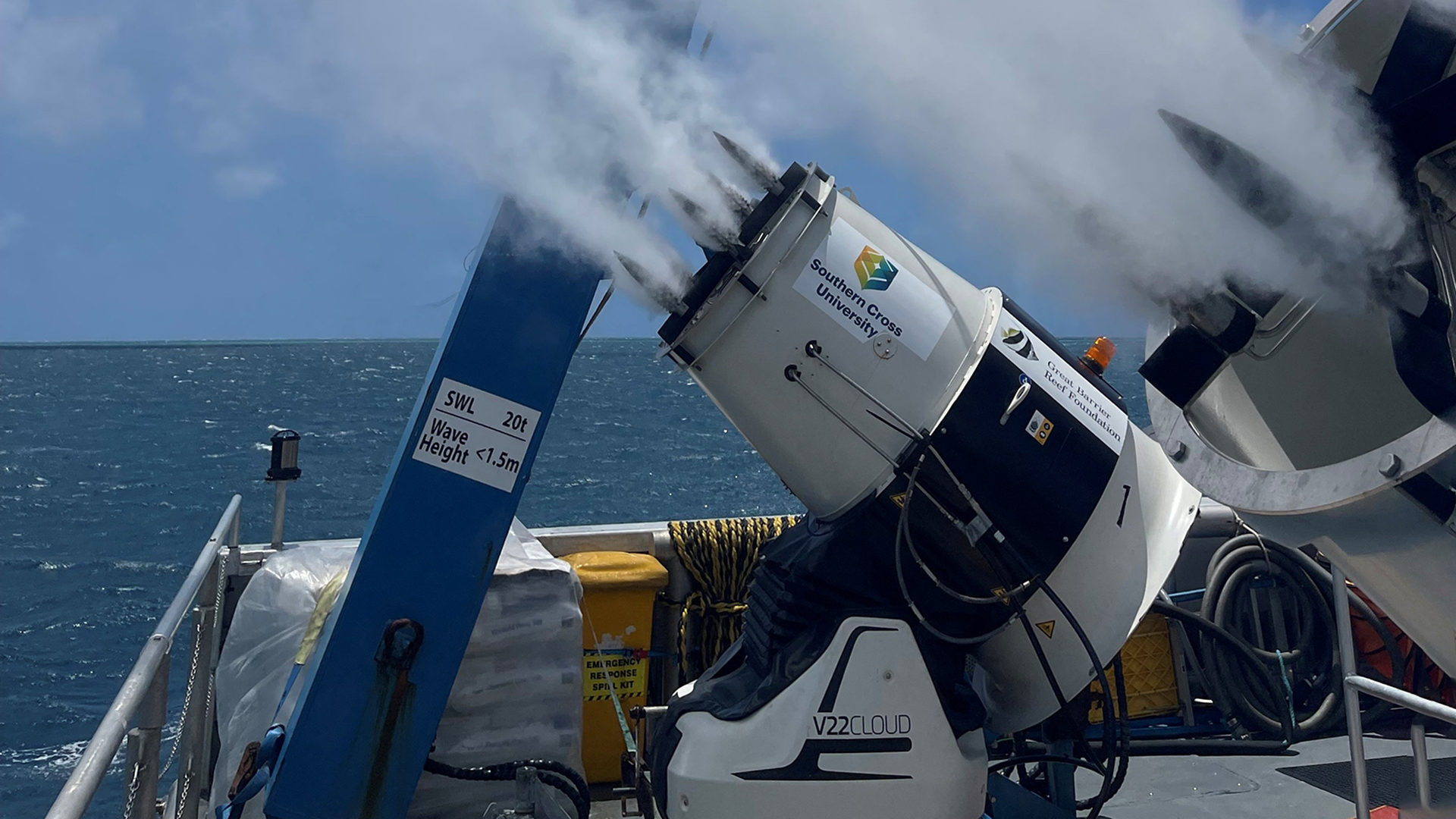
Marine cloud brightening is an experimental climate intervention designed to reduce short term heat stress on coral reefs during marine heatwaves. Led by Associate Professor Daniel Harrison, the research team has devised a system using water cannons mounted on the back of boats that spray seawater droplets into the sky through tiny nozzles.
This simulates the natural generation of sea salt cloud condensation nuclei by breaking waves on the ocean and makes clouds ‘brighter’ and capable of reflecting more sunlight away from the ocean. Field trial results indicate that with further technological development, cloud brightening should be able to provide short-term relief for coral reefs from extreme heat stress. The technique needs to be accompanied by aggressive human action to cut emissions and slow the pace of rapid ocean warming.
Drone monitoring of marine ecosystems
Research teams led by Professor Brendan Kelaher deploy autonomous aerial drones equipped with LiDAR and multispectral sensors, using AI-enhanced object-based image analysis to monitor coral bleaching, map benthic habitats, and evaluate changes in marine biodiversity.
AI-driven image processing enables rapid, high-resolution detection of ecosystem change, delivering detailed insights that support effective coastal zone management. Current projects include marine megafauna monitoring, optimising drone-based atmospheric characterisation for improved weather modelling and developing automated surveillance systems to enhance dangerous shark monitoring.
Ocean Alkalinity Enhancement for carbon removal
Associate Professor Kai Schulz contributes to international projects on Ocean Alkalinity Enhancement (OAE) for carbon dioxide removal and storage. OAE involves the controlled addition of crushed minerals or suitable alkaline agents from industrial processes into the ocean as a suitable conduit for carbon capture and storage.
This research is a partnership between Southern Cross University, UTAS, University of Hamburg, the GEOMAR Helmholtz Centre for Ocean Research (Kiel), and Dalhousie University in Halifax, Nova Scotia, with funding from the Ocean Alkalinity Enhancement R&D Program, a Carbon to Sea Initiative.
Mental health and wellbeing, co-designing with young people
Novel integration of sport and psychology
High-reach public programmes
Working with young people
Goal setting and mental health
The Open Goals Lab, led by Professor Christian Swann, translates goal-setting science into evidence-based tools for health practitioners, sports professionals, rehabilitation providers, employers and government. Research focuses on goal setting for behavioural change, best practice in sport and exercise and high-performance athletes.
Professor Swann’s work traverses sport and mental wellness. It has included ‘Ahead of the Game,’ the official programme of the Rugby League World Cup Mental Fitness Charter to improve youth mental health, delivered in partnership with men’s health charity Movember in 2022.
Healthy Esports
Esports players number in the millions worldwide, and competitive esports is a booming business, with a global audience of more than 600 million fans. A project led by Dr Dylan Poulus is developing the world’s first International Mental Health Guidelines for Esports, in collaboration with men’s charity Movember. It aligns directly with a global mission to fund scalable, prevention focused mental health initiatives for boys and men.
Research for children and young people
The Centre for Children and Young People, directed by Professor Anne Graham, investigates children and young people’s mental health and wellbeing. A distinctive feature of this research is the involvement of children as both participants and co-designers.
Projects include ethical research involving children, bullying and school safety, practical resources for children coping with grief and climate disasters, children’s experiences in the family law system and reporting family violence. Research led by Professor Lynne McPherson focuses on belonging, identity and wellbeing for children in kinship care.
Natural medicines and clinical research
Clinical trials unit
Integrative and complementary therapies
Analytical laboratory accredited by Therapeutic Goods Administration
Herbarium
Southern Cross University has built an international research profile in natural medicines and complementary therapies, anchored in the University’s National Centre for Naturopathic Medicine (NCNM).
The NCNM conducts applied clinical research into complementary medicines and integrative healthcare. Supported by a Therapeutic Goods Administration-accredited laboratory and a clinical trials centre, current trials address menopause, anxiety, diabetes, Parkinson’s disease, brain cancer and supportive cancer care.
Developing the evidence base for complementary medicines
NCNM researchers provide high-quality evidence on the safety, efficacy, and real-world use of herbal medicines, supplements, and traditional therapies. This work has informed clinical guidelines, practitioner education, and national policy.
Researchers have conducted clinical trials in naturopathic care for chronic disease management, musculoskeletal pain, and women’s health. Projects have included traditional medicine in post-viral treatment of Ebola survivors, integrative medicine in veteran and military populations, medicinal cannabis for oncology patients and the effect of nutrition on the mental health of young men.
Influencing policy and Indigenous Knowledge protection
Research has influenced national accreditation frameworks for naturopathy and contributed to international datasets on complementary medicine use.
Dr Alana Gall leads work on protecting and preserving Indigenous Traditional Medicines and improving accessibility for Indigenous communities across Australia.
Applied entomology
Insect research labs and farms
Industry partnerships
Extension for sustainable development
Bee research and pollination security
Led by Dr Cooper Schouten, the Bee Research and Extension Lab focuses on honey bee health, pollination, and sustainable apiculture. This includes affordable integrated pest management strategies, supporting queen bee breeding for Varroa destructor mite, which threatens Australia’s food security and biodiversity, detection of Tropilaelaps mites in European honey bee (Apis mellifera) colonies, biodiversity and agribusiness development.
The Lab promotes innovations in beekeeping technology and delivers education and extension programmes to empower beekeepers across Australia and the Indo-Pacific, with projects also in Ghana and Morocco.
Black Soldier Fly farming
Researchers, including Dr Lachlan Yee, Professor Nigel Andrew and Dr Owen Hogan, have established an on-campus black soldier fly research farm, powered by food waste from local businesses. These flies are highly efficient at breaking down organic food waste, with larvae capable of consuming twice their body weight daily. By-products include fertiliser and protein feed.
Beyond waste management, researchers are exploring the use of chitin, a compound found in the flies’ exoskeletons, as a base for biodegradable polymers like chitosan.
Fire Ant control
Invasive fire ants (Solenopsis invicta) pose risks to many native species and human health and have now spread to more than a million hectares in Australia since being first detected in 2001. Professor Nigel Andrew leads research into nest removal and eradication strategies, including the validation of a hot water injection method for Australian conditions known as FASO (Fire Ant Soup Operation).
Post-flood monitoring and catchment management
Large-scale water quality monitoring
Research fleet
Citizen science modelling
Environmental DNA studies of estuaries
Following major flooding, a team led by Dr Maarten De Brauwer conducted eDNA mapping of New South Wales estuaries, surveying more than 230 sites along a 1,000km stretch of coastline. Using eDNA metabarcoding, the team identified genetic traces from more than 7,000 species, including invasive species, forming a biodiversity baseline for post disaster recovery and long term ecosystem management.
Government agencies are using the data to inform fisheries management, threatened species recovery and estuary health assessments.
Water and nutrient management
A project led by Professor Damien Maher and Dr James Sippo involves large scale monitoring of nutrient processing in the Hawkesbury River, Sydney’s most significant river system. Drawing on more than 10,000 samples, the project data is informing infrastructure planning and water quality management amid rapid urban expansion.
Methane cycling and carbon modelling in ecosystems
Professor Damien Maher and Dr Luke Jeffrey lead projects on methane-consuming microbes in tree bark, while Professor Bradley Eyre leads ecosystem-scale carbon cycling modelling across wetlands and coastal environments, including inland deserts. This body of research has contributed directly to national and international carbon accounting studies, including the Intergovernmental Panel on Climate Change.
Citizen science and river health monitoring
Professor Scott Johnston leads large-scale catchment surveys in New South Wales of the Clarence and Macleay Rivers. The project trained dozens of citizen scientists to collect water and sediment samples and has produced long-term datasets on mining pollutants and seasonal variability.
The model delivers robust scientific data while empowering local communities and regulators. It offers a scalable approach to environmental governance, integrating citizen science within formal assessment frameworks.
Opportunities for collaboration
Access to subtropical and Southern Hemisphere field sites
Established partnerships with industry and government
Experience in applied and translational research
Capability in interdisciplinary and co-designed methodologies.
CRICOS Provider No: 01241G | TEQSA: PRV12043 Australian University
Please Note: This is a Commercial Profile
Please note, this article will also appear in the 26th edition of our quarterly publication.
Source link

