Training next-generation innovators at the Maastricht Science Programme
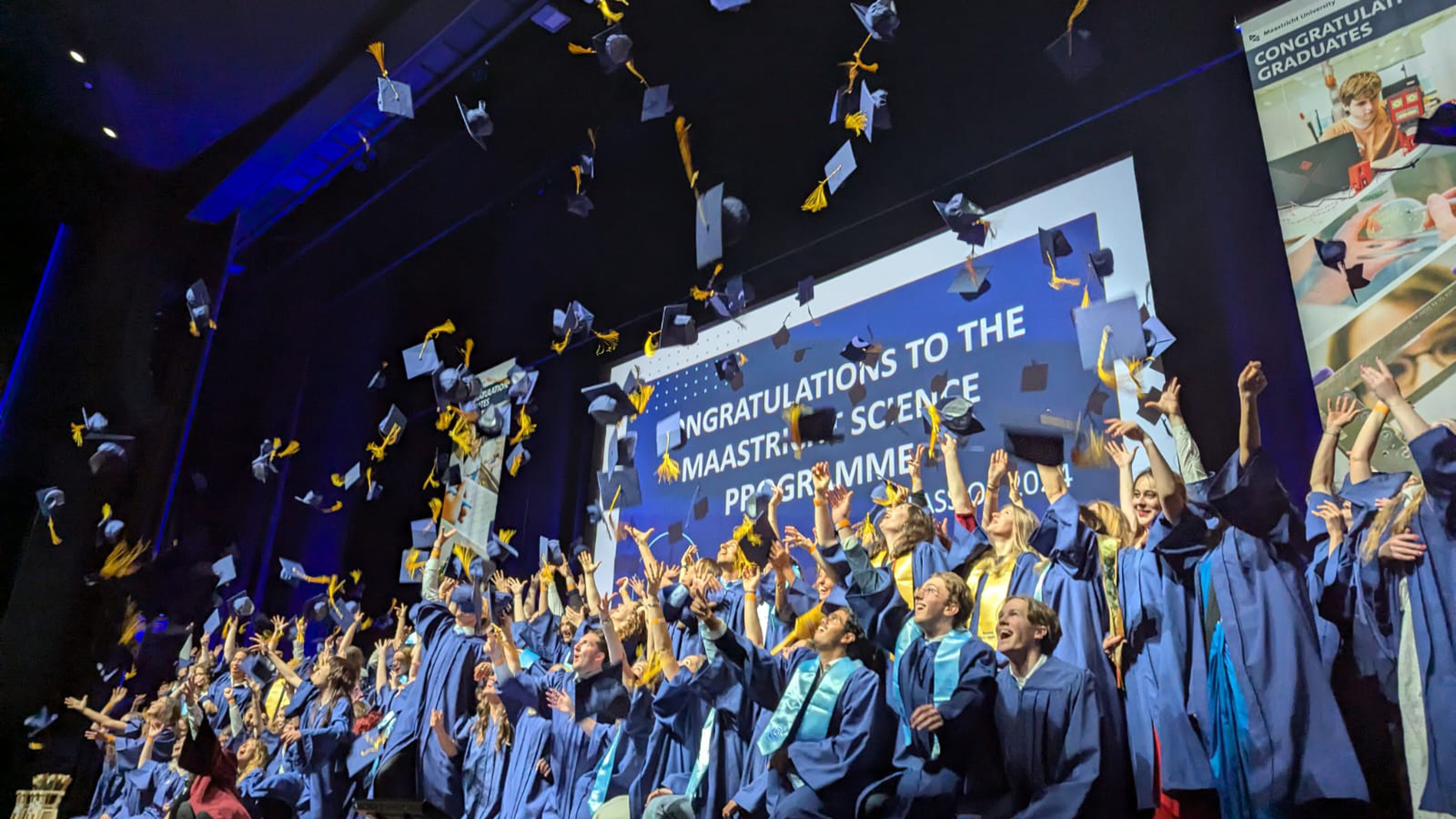
The most pressing scientific and societal challenges of this century rarely stay inside the boundaries of a single discipline. At Maastricht University, the Maastricht Science Programme trains future innovators who can move fluidly across fields rather than retreating into one
Ask a roomful of scientists what the defining problems of the next decade will look like, and a pattern soon emerges: very few of them sit neatly inside one discipline. Climate change is simultaneously a problem of chemistry, physics, economics, and human behaviour. Emerging infectious disease moves at the intersection of biology, data science and public policy. Personalised medicine depends as much on computation as on cell biology, and artificial intelligence (AI) is now reshaping how almost all of the above are studied in the first place. Modern science, in other words, rarely advances within the limits of a single field.
The Maastricht Science Programme (MSP) at Maastricht University has built its educational philosophy around a simple premise: the researchers capable of solving tomorrow’s problems will need to think comfortably across disciplinary boundaries, integrating ideas, methods, and perspectives wherever the problem demands it. MSP exists, quite deliberately, to prepare students for that environment. It is a three-year, English-language Bachelor of Science that pairs rigorous training in the natural sciences with the flexibility to shape a genuinely individual academic pathway, and it asks something unusual of its students from day one. Not “which discipline will you specialise in?”, but “what kind of scientist do you want to become?”
It is worth dwelling on how unusual that second question still is within higher education. Most science faculties are built around the opposite assumption: that students arrive already knowing roughly where they belong, and that the job of a degree programme is to deepen that initial choice as efficiently as possible. MSP starts from a different premise entirely, rooted in the Liberal Arts and Sciences tradition: genuine scientific identity tends to emerge more through exposure and less from early declaration. The conventional disciplinary boundaries between biology, chemistry, mathematics, and physics are treated as a starting point to work from rather than a fence to stay inside, because forcing a decision too soon risks closing off exactly the cross-disciplinary instincts that contemporary research increasingly rewards.
An education built on crossing boundaries
Most conventional degree programmes ask students to commit early, narrowing their academic path from the first year onwards. MSP takes the opposite approach and gives students a broad scientific foundation before encouraging them to develop an individual academic pathway. Core courses in biology, chemistry, physics, mathematics, and the humanities and social sciences sit alongside electives spanning neuroscience, molecular life sciences, data science, Earth sciences, and didactics, allowing students to combine subjects in ways that reflect their developing interests.
That freedom is not simply a matter of timetable design. It reflects something closer to a conviction about how science is actually practised today, and about how rarely real research problems announce which department they belong to. A question about antibiotic resistance might pull in microbiology, chemistry, and statistics within the same afternoon. A question about renewable energy storage might need materials science, physics, and environmental modelling in roughly equal measure. Training students to move between those registers comfortably is less a stylistic preference at MSP than a working assumption about what the job will actually require of them.
Developing that kind of intellectual agility does not happen by accident. Students need enough freedom to explore, but also enough guidance to ensure exploration becomes expertise. That level of flexibility only works if someone is helping students use it well, which is why every MSP student is assigned a dedicated academic advisor for the duration of their studies. The advisor’s role is less about administration than ongoing academic coaching. They help students translate their interests and talents into a coherent programme of study. They also advise on opportunities to take courses in other faculties — or even at other universities — and help students prepare for the master’s programme or career they ultimately hope to pursue.
Learning by investigating, not absorbing
What makes that kind of fluency possible in practice is as much a matter of pedagogy as of course content. Education at MSP is intentionally personal: class sizes are kept small to encourage real interaction between students and academic staff — a deliberate departure from the lecture-hall anonymity common to large science faculties elsewhere. Teaching follows Maastricht University’s internationally recognised Problem-Based Learning (PBL) approach, which places students at the centre of the learning process instead of the lecture.
In practice, this means students are rarely handed conclusions to memorise. Instead, they investigate authentic scientific questions, the kind without tidy textbook answers, and work through them in tutorial groups: weighing evidence, discussing its limitations, and learning to build arguments robust enough to survive a roomful of peers asking awkward follow-up questions. It is a slower, more deliberate way of learning than passive lecture attendance. But it produces something that lecture-based courses can struggle to deliver: graduates who have actually practised the mechanics of scientific reasoning, rather than simply absorbed its conclusions secondhand.
The effects of that habit extend well beyond any single subject. Years spent learning this way build communication, collaboration, project management, and critical thinking, skills that remain valuable regardless of which corner of science, or which career entirely, a graduate eventually lands in. They are, in a sense, the durable residue of the method: still useful long after the specific content of any one tutorial has been forgotten.
At a Glance: English-language BSc • Three-year programme • Interdisciplinary Liberal Arts and Sciences curriculum • International classroom • Research-intensive • Flexible degree structure
From foundation to focus
The curriculum is deliberately structured to develop both breadth and depth. In the early stages of the programme, students move through the major scientific disciplines while building the quantitative reasoning and laboratory competence that everything afterwards depends on. Only as their interests begin to crystallise, typically once they have had real exposure to several fields, do students begin constructing the academic profile aligned with their own ambitions.
Research is not bolted on at the end of the programme as a final-year flourish; it runs through the curriculum from the outset and in close partnership with working. MSP’s own dedicated scientific staff are central to that approach, bringing their research directly into the classroom and laboratory while working closely with students throughout the programme. Students have direct access to modern teaching and research laboratories, where they learn experimental design, statistics, scientific writing and responsible research practice alongside extensive practical experience. They apply those skills during twice-yearly three-week project periods before embarking on a full-semester Bachelor Thesis Research project, an extended piece of independent research that allows them to tackle an original scientific question in depth under academic supervision. By graduation, they understand not only the scientific theories that underpin their discipline, but also how new knowledge is generated, tested, challenged and communicated—an understanding that often distinguishes confident early-career researchers from those still learning the mechanics of research in their first professional role.
That same problem-based-learning approach, which shapes day-to-day teaching, also turns the classroom into something closer to a working research community. Students analyse realistic scientific scenarios, identify the gaps in their own understanding, divide research tasks among themselves, and return prepared to debate their findings with the group. Academic staff remain present throughout, but more in the role of facilitator than as a lecturer: nudging students toward intellectual independence and curiosity instead of supplying the answer outright, even when it might be faster to do so.
A classroom shaped by the world it studies
That independence is sharpened further by exactly who else is in the room. MSP’s student population is deliberately international, and that diversity is an integral part of the educational experience and not just a demographic statistic. Students collaborate with peers from a wide range of cultural and educational backgrounds, a composition that mirrors the genuinely global nature of contemporary science itself, where research teams routinely span several countries and traditions before a single paper gets written.
That diversity has a more specific effect on how students learn to reason, beyond the general case for broadened horizons. Working alongside classmates trained to approach problems differently, to ask different first questions, or to trust different categories of evidence, pushes students to defend their own thinking more rigorously than a more homogeneous classroom would demand. It also builds, almost as a byproduct, exactly the kind of cross-cultural communication skill that international research collaboration now treats as a baseline requirement and not as a nice-to-have. As one observation from within the programme frames it, the scientists who will make tomorrow’s breakthroughs are those who can integrate knowledge across disciplines while collaborating effectively with experts from around the world. MSP’s classroom is, in miniature, a rehearsal for exactly that.
From classroom to active research
That ambition has somewhere concrete to land, thanks to MSP’s position within Maastricht University’s Faculty of Science and Engineering. Students are not taught about research from a distance; they have genuine opportunities to interact with active researchers and modern research facilities, and to pursue independent projects built around questions that interest them personally, experiencing research as a process of discovery rather than something encountered only after graduation. That sequencing matters more than it might first appear. A student who has already run an independent project, however modest in scope, arrives at postgraduate study with a working sense of how research actually unfolds in practice: the false starts, the refined hypotheses, the slow accumulation of evidence that rarely matches the tidy narrative a finished paper presents. That familiarity is difficult to teach in the abstract and considerably easier to absorb by doing the work.
It is the flexibility built into the degree that allows those projects to take such different shapes from one student to the next. One might combine molecular biology with chemistry and mathematics to build a foundation for drug discovery research. Another might bring together physics, computer science, and mathematics to specialise in computational modelling and fundamental research. A third might pair ecology with environmental chemistry and data analysis, working toward a future in sustainability research. None of these students follow quite the same route through the programme, and that variation is rather the point: MSP operates on the premise that scientific careers are seldom identical to one another, so the path leading toward one should not be standardised either.
Where the pathway leads
That flexibility tends to pay dividends at the next stage. A significant number of MSP graduates move on to competitive master’s programmes across Europe and beyond, in fields ranging from biomedical sciences, neuroscience and palaeontology through to computational biology, elementary particle physics, artificial intelligence and analytical chemistry. The breadth of that list is itself telling: it would be unusual for a single graduating cohort from a more narrowly specialised programme to scatter across quite so many directions, and harder still for each of those graduates to arrive at their chosen master’s with the multidisciplinary grounding to hit the ground running instead of spending a first semester catching up on adjacent fields they were never taught.
Others move directly into industry, where interdisciplinary thinking is increasingly valued and increasingly necessary across biotechnology firms, pharmaceutical companies, and sustainability- and innovation-driven businesses more broadly. Few of those sectors have much patience left for graduates who can only operate competently within one narrow lane of expertise; a biotech start-up developing a new diagnostic, for instance, prefers people equally comfortable discussing the underlying biology, the data pipeline, and the regulatory chemistry all at once, over three separate specialists who each understand only their own corner of the problem.
What graduates carry forward into either path tends to extend well past technical know-how. A working confidence in presenting scientific information, a habit of evaluating evidence critically and not accepting it at face value, genuine comfort operating inside multidisciplinary teams, and the capacity to adapt as the scientific landscape shifts beneath them: these are the transferable capabilities that hold up across an entire career defined by continual innovation, long after the specific content of any individual course has faded from memory.
Key Strengths: Personalised mentoring • Interdisciplinary curriculum • Authentic research experience • International outlook • Strong postgraduate preparation
Preparing scientists for a future that won’t wait
Tackling the scientific and societal challenges of the future will depend, almost by definition, on collaboration across disciplines, institutions, and national borders. That places a particular responsibility on universities: not simply to produce technically capable graduates, but intellectually adaptable ones, equipped to move into problems they were never specifically trained to solve.
MSP offers one response to that responsibility, built not around a single subject but around a way of approaching unfamiliar ones. The programme encourages each student to build an individual scientific identity grounded in curiosity, analytical thinking and evidence-based decision-making. What graduates leave with is not only subject knowledge but the confidence to ask ambitious questions, and the working habits required to collaborate productively with specialists from fields quite different from their own — an increasingly non-negotiable skill as research itself becomes more collaborative and less siloed by the year.
As society confronts challenges that refuse to respect disciplinary lines, the need for scientists who can bridge disciplines shows no sign of shrinking. If anything, the gap between problems that are inherently interdisciplinary and graduates trained to handle only one slice of them looks set to keep widening. MSP’s wager is that the graduates best placed to contribute meaningfully to those conversations, through research, innovation and a sustained habit of lifelong learning, are exactly the ones it has spent three years training not to specialise too soon.
For prospective students drawn to a rigorous yet genuinely flexible science education set inside an international classroom, MSP represents a chance to develop scientific excellence and personal growth in tandem. Its combination of research-led teaching, student-centred learning and interdisciplinary exploration is built to leave graduates ready not just for whatever comes immediately after graduation, but for whatever shape the scientific problems of the next decade happen to take.
Please Note: This is a Commercial Profile
Please note, this article will also appear in the 27th edition of our quarterly publication.
Source link

